Every transformation has a starting point, but not all of them are obvious at first glance. In this case, the opportunity wasn’t a lack of ambition: it was the need for greater alignment behind an already strong vision.
Before diving into growth targets, workflows, or leadership structure, it became clear there was an opportunity to strengthen how the leadership team communicated, shared information, and operated against a unified set of expectations. Like many growing organizations, key decisions and insights weren’t always flowing as consistently as they needed to.
At the same time, the board was taking a closer look at executive compensation. Specifically, they wanted to understand how the CEO’s performance and incentives were structured. What we found was a system that had evolved over time: documents were static, formulas weren’t clearly defined, and compensation wasn’t directly tied to the scorecard the board believed was in place. The CEO’s bonus, while meaningful, was largely discretionary rather than driven by transparent, performance-based metrics.
This was the environment we stepped into: a high-performing organization with ambitious goals, a committed leadership team, and clear momentum, but with an opportunity to bring more structure, visibility, and alignment to support the next phase of growth. The stakes were high, and so was the potential. What followed was a shift from complexity to clarity, from individual effort to shared alignment, and from strong performance to scalable, sustainable growth.
The Challenges Beneath the Surface
As we dug deeper, it became clear that the firm wasn’t facing just one challenge—it was navigating a web of interconnected issues that were quietly limiting its ability to grow.
At the highest level, growth expectations themselves were misaligned. The board had set ambitious targets: nearly doubling AUM and more than doubling revenue. Those goals, however, weren’t grounded in the firm’s current capacity, infrastructure, or resources. Without a realistic path to get there, the targets created pressure rather than progress.
At the same time, key internal pathways lacked clarity. The next-in-line Lead Advisor had no clearly defined path to partnership. There were no structured milestones, measurable expectations, or alignment with future goals. This made it difficult to motivate, retain, and properly develop rising talent.
Business development efforts were equally fragmented. There was no cohesive strategy tying together marketing, content, and sales. Ideas were abundant, but execution lacked focus, resulting in inconsistent messaging, low conversion efficiency, and missed opportunities to generate qualified leads.
Operationally, the cracks were just as evident. Core processes like client onboarding, review meetings, and internal workflows were inconsistent or undocumented, leading to inefficiencies and a client experience that varied more than it should have.
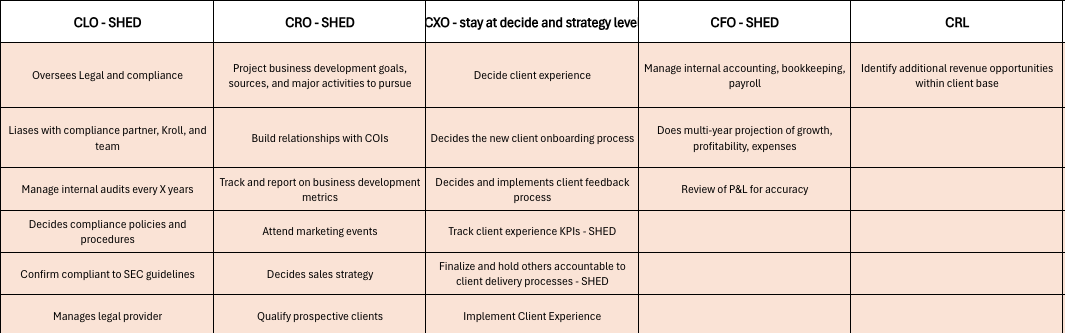
Meanwhile, the team itself was stretched thin. Critical roles, including a Client Service Associate and a Business Development Advisor, were unfilled, and hiring processes lacked structure. This placed even more strain on leadership. This most impacted the President, who was effectively operating across nearly every executive function at once, from CEO to CMO to Lead Advisor.
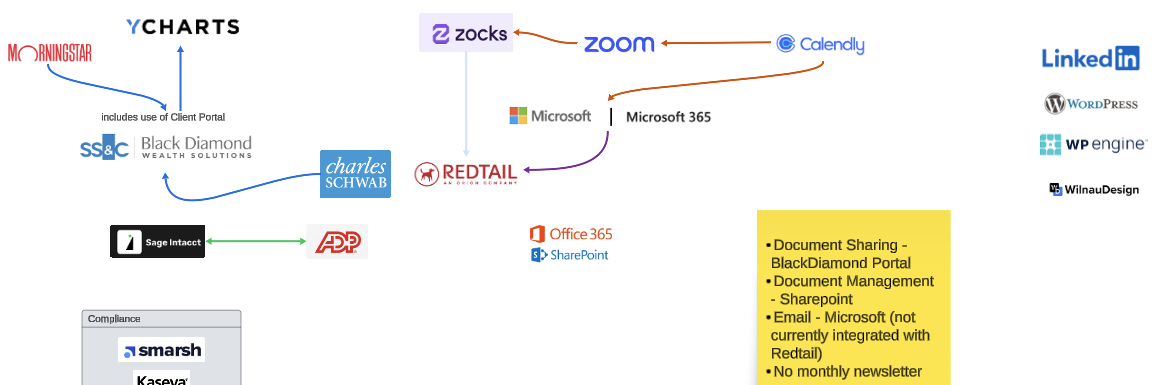
Compounding all of this was a fragmented technology stack. Essential tools were either missing or underutilized, and limited CRM adoption created unnecessary manual work that slowed the team down.
Finally, there was a deeper issue influencing decision-making: incentives were not fully aligned with long-term business growth. Leadership focus often skewed toward personal compensation rather than reinvesting in the team and infrastructure needed to scale sustainably.
Individually, each of these challenges was manageable. Together, they created a system that made growth far more difficult than it needed to be.
How We Stepped In
Creating Immediate Clarity & Alignment
We started by bringing structure to the chaos. A centralized master plan in Asana gave every initiative a clear owner, defined deadlines, and full visibility across the organization. What had previously felt scattered and reactive quickly became organized, prioritized, and accountable.
Building a Measurable Path to Partnership
Next, we created a clear and measurable Path to Partnership for a key leader. By tying both qualitative and quantitative metrics to performance (including revenue, leadership, referrals, and firm contributions), we established not just expectations, but a motivating roadmap for growth and advancement.
Rebuilding Business Development from the Ground Up
Business development shifted from a collection of disconnected efforts into a structured, repeatable system. We implemented defined lead and prospect workflows, developed a cohesive pitchbook, introduced a consistent content strategy tailored to financial services, and brought visibility into the pipeline through proper CRM tracking and opportunity management.
Standardizing Core Operations
To reduce inefficiencies and improve consistency, we documented and refined critical workflows. From new client onboarding to ongoing review meetings, the team gained clear processes that improved both internal execution and the overall client experience.
Implementing Talent Development Systems
We introduced structured systems to support long-term team growth, including our Life Career Mission Statement (LCMS) framework, quarterly State of the Company meetings, and clearly defined roles, responsibilities, and career paths. This created stronger alignment, engagement, and direction across the team.
Strengthening Hiring & Onboarding
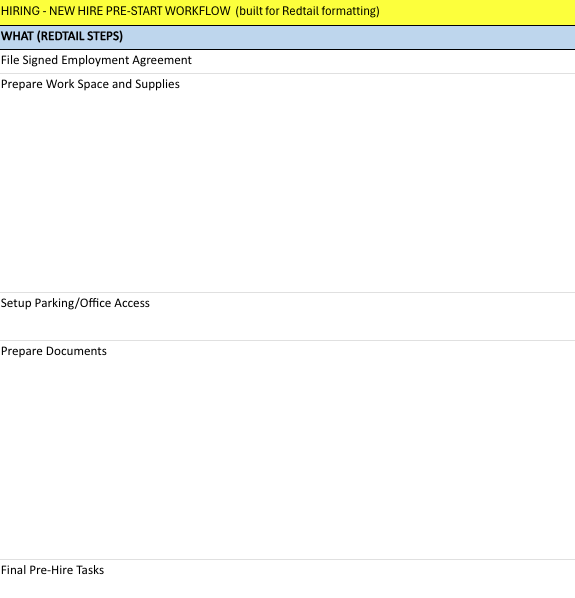
To address capacity constraints, we built a more consistent and effective hiring process, from job descriptions and postings to candidate assessments and onboarding workflows. This ensured the firm could attract, evaluate, and ramp new talent with far greater efficiency.
Designing a Future-Ready Tech Stack
We identified key gaps in the firm’s technology and developed a forward-looking roadmap to address them. By introducing the right tools and integrations, we helped position the team to reduce manual workload, improve speed, and operate more efficiently at scale.
Driving Early Momentum & Quick Wins
Early in the engagement, we focused on generating momentum. Through time savings, improved client experience, and stronger referral activity, the team began to see tangible progress quickly which helped rebuild confidence and energy across the organization.
Empowering Rising Leaders
A critical shift was moving execution beyond the top. We empowered up-and-coming leaders to take ownership of high-impact initiatives, redistributing responsibility and building the internal capability needed to sustain long-term growth.
Expanding Strategic Options for the Board
Finally, we ensured leadership wasn’t limited to incremental improvements. We introduced and evaluated broader strategic paths, including a potential sale, rebuilding with a modern structure, or pursuing acquisition-led growth. This enabled the board to make fully informed decisions about the firm’s future.
The Results
With the right structure in place, the firm began to operate with greater clarity, consistency, and confidence.
They redefined growth targets to align with actual resources and realistic pathways forward. Business development became a repeatable, data-driven engine rather than a collection of disconnected efforts. And the Path to Partnership provided a clear, motivating roadmap for future leadership.
Operational improvements, including use of a client operations and experience chart, led to a much more consistent client experience and greater internal efficiency.
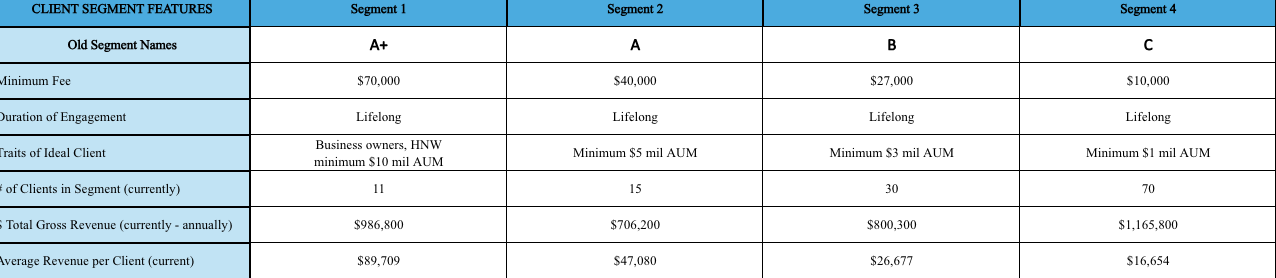
Stronger hiring and onboarding systems reduced the time it took for new team members to become fully effective.
Leadership was no longer overwhelmed. With clearer roles and better systems, responsibilities were distributed more effectively, allowing leaders to focus on higher-value work.
At the same time, team engagement improved. With clearer expectations, defined growth paths, and regular development rhythms, employees became more invested in both their own success and the firm’s future.
Perhaps most importantly, rising leaders began to step up to take ownership of meaningful work and contribute in ways that strengthened the organization as a whole.
Key Takeaways
What this engagement reinforced is simple: growth doesn’t break businesses: lack of structure does.
Without clear roles, documented processes, and aligned incentives, even the most ambitious goals can create friction instead of progress.
When those foundational elements are in place, however, everything changes:
- Leaders gain the space to think strategically instead of constantly reacting.
- Teams operate with greater confidence and consistency.
- Growth becomes something the organization can support, not something it struggles to keep up with.
Sustainable success ultimately comes from evolving the entire system: people, productivity, profitability, and presence.
Why It Worked
Looking back, we stepped into an organization weighed down by misalignment and overwhelmed leaders. Even the most ambitious goals were out of reach without a solid foundation.
By addressing the root causes (unclear roles, fragmented processes, inconsistent communication, and misaligned incentives) we were able to turn confusion into clarity and stagnation into momentum. Through structure, transparency, and a focus on empowering rising leaders, we didn’t just check off a list of fixes.
We redefined the way the team operates and collaborates. Today, with streamlined operations, a clear path to partnership, and energized leadership, the firm isn’t just chasing growth targets. It’s positioned to achieve them, sustainably and confidently, for years to come.
Will You Be Next?
At My Virtual COO, we help a founder-led service businesses identify and implement improvements and techniques that accelerate business and team success.
- Time and Energy
- Plan of Improvements
- Growth Goals and Finances
- Team Design and Hiring
- Processes
- Client Experience
- Utilization of providers
Ready for your own transformation? We would love to speak with you.